From a reconstruction project to SCHEIDT GmbH & Co. KG’s largest site
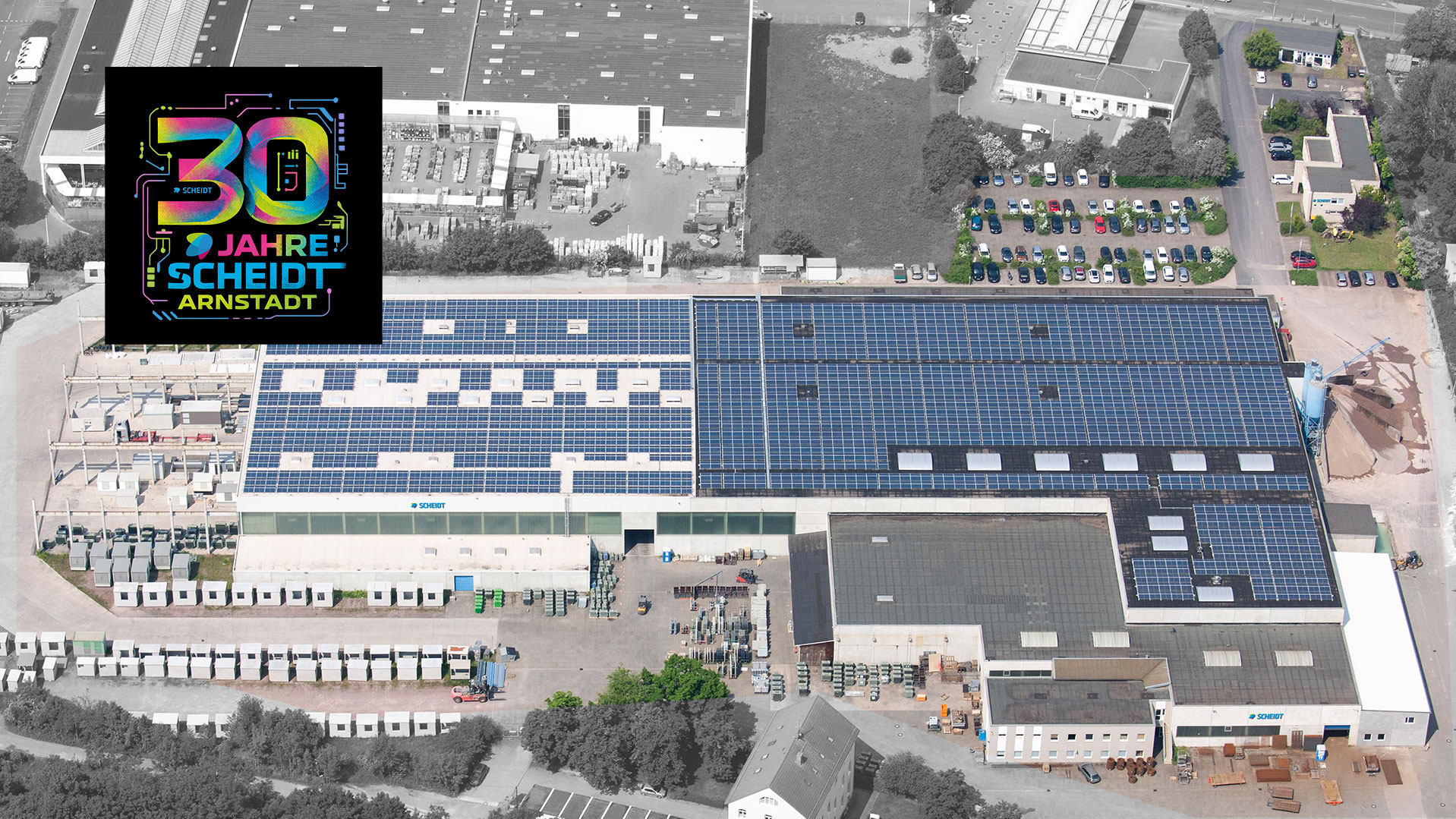
The Arnstadt plant was launched in 1996. The choice of location was no coincidence: thanks to its direct links to the motorways, Arnstadt offers ideal conditions for supplying customers in the southern, eastern and western regions of Germany.
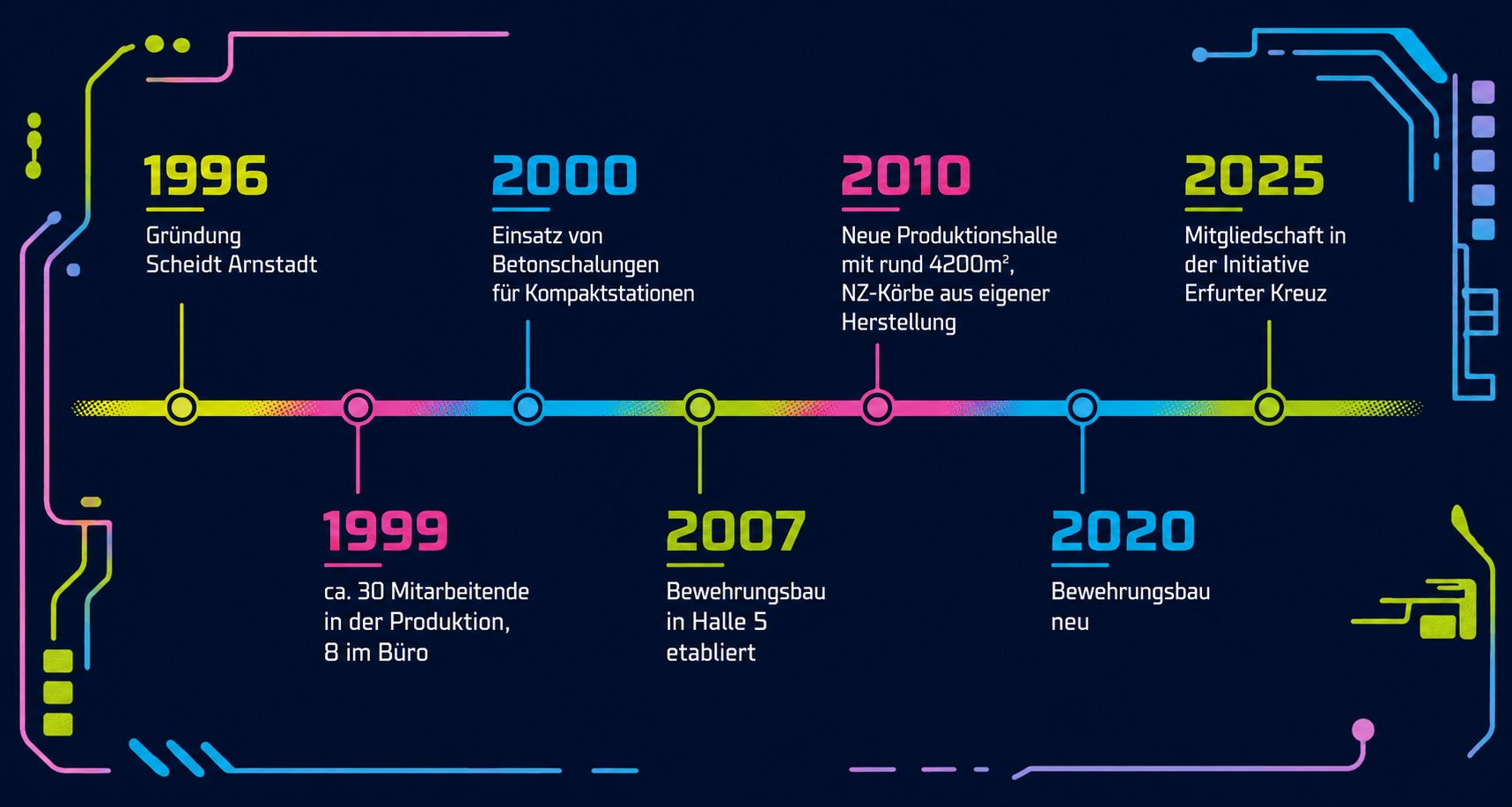
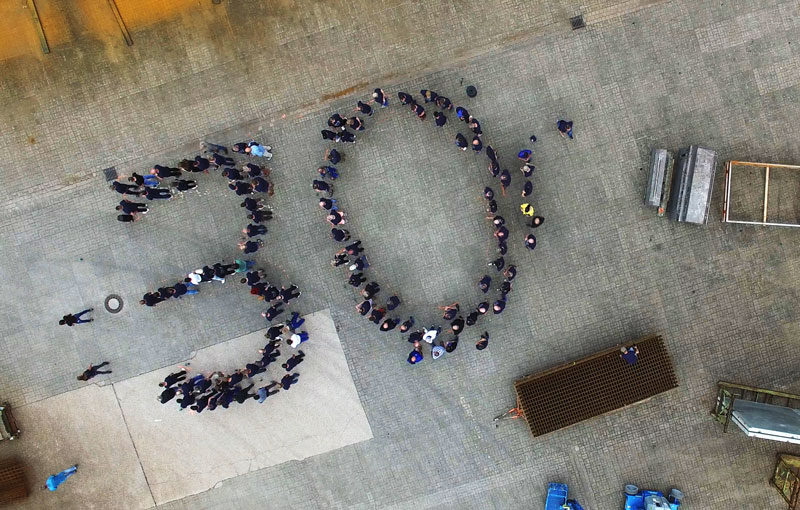
What began as a consistent Expansion of production capacity began, and over the course of three decades has developed into the Scheidt’s largest site has developed. Today, 124 staff members work here, including six apprentices in technical and commercial trades such as technical systems planning, concrete and reinforced concrete construction, and electronics for building services engineering. By way of comparison, in 1999 there were around 30 employees in production and eight in the office.
The following are manufactured Transformer stations weighing up to 80 tonnes, including full electrical fit-out. On average, it takes around 180 man-hours to manufacture a transformer station until it is ready for dispatch.
Growth with a clear outlook
With the official Founded in 1996 Arnstadt became an integral part of the group of companies. The site on Ichtershäuser Straße has a long industrial history: concrete and precast concrete elements were already being produced here before German reunification. The current production halls were built after 1990 and formed the basis for the company’s subsequent development.
With Scheidt’s launch in 1996, production of the first stations and shafts began. In the early days, garages were also manufactured at the site at 63 Ichtershäuser Straße.
The site developed rapidly. As early as the early 2000s, targeted investments were made in its expansion, particularly in the increased use of concrete formwork for compact stations.
As a result, Scheidt increasingly established itself as a reliable partner for customers in southern Germany. A growing number of projects and long-term framework agreements led to rising demand for production capacity.
The response to this was another Milestone: In 2010, a new production hall covering around 4,200 m² was built. By extending the existing halls from around 90 to approximately 160 metres, the production areas were significantly expanded. This investment continues to form the basis for the site’s further growth to this day.
Modernisation, sustainability and responsible local development
A production site is subject to a constant change. Equipment such as mixers, cranes and concrete formwork eventually reaches its technical limits and needs to be replaced. However, simply replacing it is only part of the process. What is crucial is a constant focus on optimisation and modernisation.
At the Arnstadt site, this commitment has been consistently put into practice. Over the past ten years, key plant equipment has not only been replaced but also specifically upgraded. Among other things, the previous ring trough mixer has been replaced with modern technology. The Today's mixing tower has two outlets, so that the concrete can be channelled to an additional production hall via the shortest route.
This reduces internal transport distances, conserves resources and improves both quality and efficiency. At the same time, production times are shortened and processes are stabilised.
In the field of Formwork technology Significant progress has been made. Around 75 per cent of the older compact-station formwork has been replaced by a new generation. This was developed in close collaboration between the site’s concrete foremen and the manufacturer. A key advantage is that a crane is no longer required to operate the system. This not only increases efficiency but, above all, improves health and safety. At the same time, the Crane systems modernised. Today, almost all systems are fitted with wireless remote controls, enabling staff to work at a safe distance. Another important step is the digital integration of production. Large-format monitors clearly display current order data and work stages across all areas. Feedback can be recorded directly, improving the management of processes. An expansion to include additional functions, such as a ticketing system, is also planned by the end of 2026.
In-house production as a strategic advantage
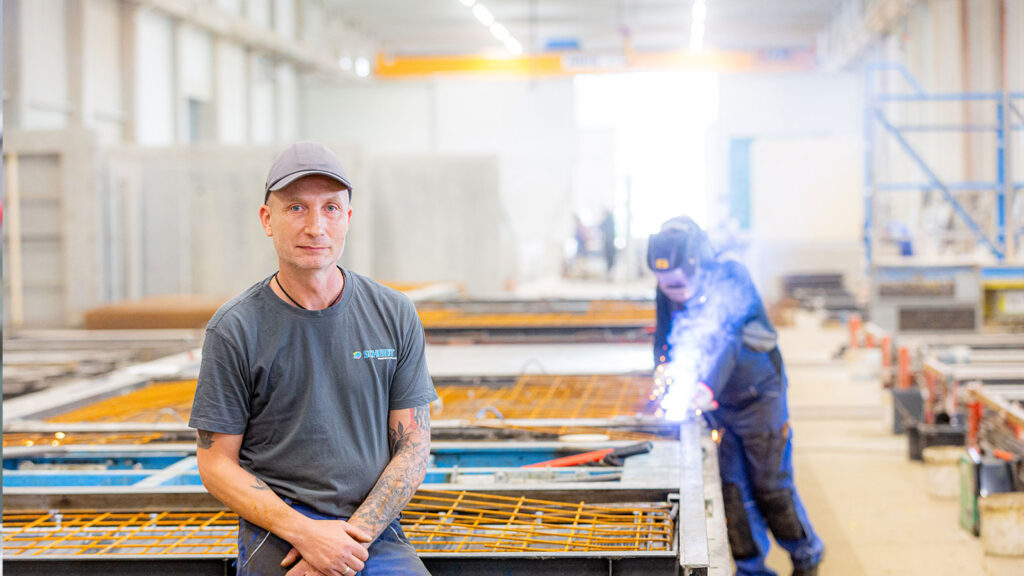
Since July 2007, the reinforcement division has been permanently based in Hall 5. In 2020, the area was expanded by a further 200 m² or so, and the company began manufacturing its own NZ reinforcement cages. These are Reinforcement cages for non-accessible stations of a modular design, i.e. those manufactured on site Compact stations.
Previously, a large proportion of the reinforcement was sourced externally. This was not only less cost-effective, but also environmentally harmful. Transporting the reinforcement cages involved moving large volumes of material with a comparatively low proportion of actual reinforcement.
By integrating this into our own value chain, we have been able to eliminate this disadvantage entirely. At the same time, in-house production increases the Flexibility and responsiveness as requirements change.
The Vehicle fleet The forklift fleet is constantly being modernised. Whenever an old forklift is taken out of service, this provides an opportunity to switch specifically to modern electric models.
The Office infrastructure is being further developed. The former gatehouse, which previously housed a hairdressing salon, has been undergoing extensive renovation since 2025 to create additional office and meeting rooms.
In 2024, the plant set a new site and company record with 1,560 units delivered.
Embrace challenges, demonstrate strength
The year 2026 will also bring significant challenges for the energy sector. The limited availability of medium-voltage switchgear means that production capacity cannot be utilised to full capacity at all times.
In recent years, capacity has been specifically expanded as part of the energy transition. Some of this capacity is now available at short notice, without there being any reliable prospects for its utilisation.
The Arnstadt site reacted at an early stage. As early as 2025, opportunities in other areas were identified and appropriate measures were put in place. This made it possible to significantly mitigate the impact.
All jobs have been safeguarded. At the same time, this once again highlights the site’s key strength: a high level of team spirit and the ability to respond flexibly to new situations.
SCHEIDT GmbH & Co. KG has been a member of the Erfurter Kreuz e. V. initiative since 2025. The association brings together more than 160 companies and is committed to the region’s economic development.
The aim is to further strengthen the region, secure a skilled workforce and expand cooperation between business, politics and education.
Through its membership, Scheidt is actively involved in this network and participates in knowledge-sharing and joint projects. This not only strengthens the site itself, but also contributes to the sustainable development of the region.