
Turnkey Transformer stations
directly from the manufacturer
One Transformer station (also Transformer station (as it is known) connects the medium- and low-voltage grids and is therefore the backbone of any reliable energy supply. SCHEIDT manufactures Transformer stations Available in all standard designs and for all applications – from compact local distribution substations to walk-in custom solutions with bespoke interior fittings. Turnkey, watertight and oil-tight, designed for a service life of around 50 years.
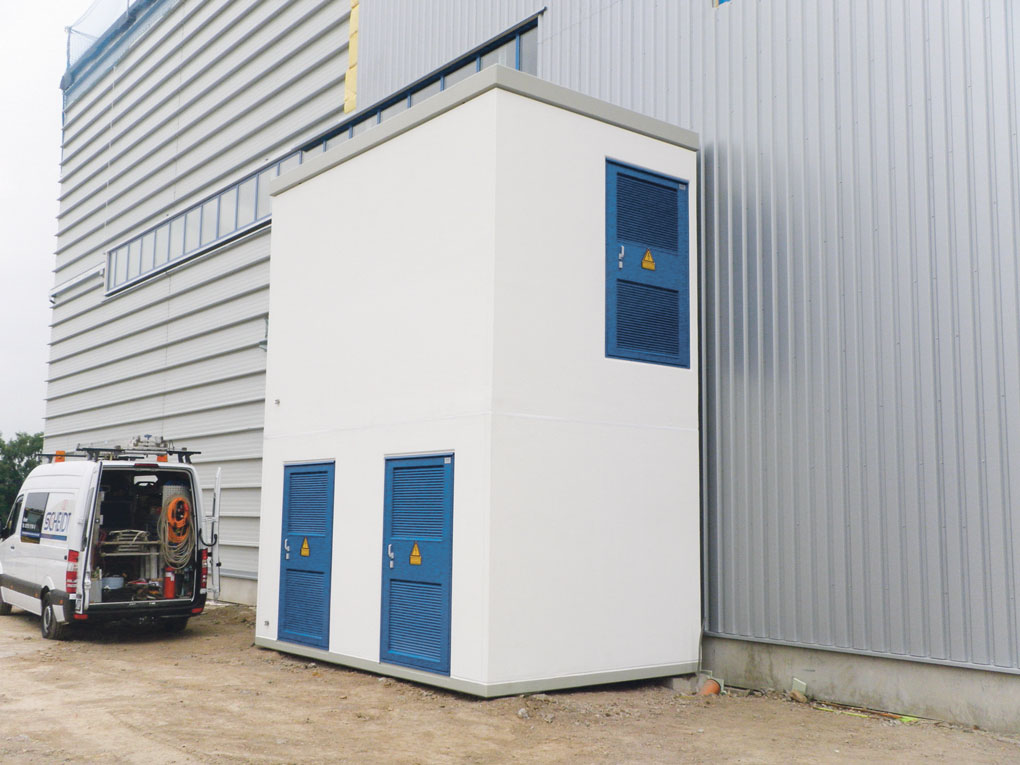



Transformer stations for every application
What is a transformer station?
One Transformer station is an electrical installation that converts medium voltage (usually 10 to 20 kV) to low voltage (230/400 V) – or vice versa. The core component of every Transformer station is the transformer, which is why the term Transformer station is used synonymously. Depending on the location, function and network level, various terms have become established, such as network substation, local network substation or transfer substation. In terms of construction, a distinction is made between accessible substations with an interior and non-accessible compact substations, which are operated exclusively from the outside.
SCHEIDT manufactures Transformer stations as precast reinforced concrete buildings. They offer good fire protection and are completely watertight and oil-tight without the need for additional coating, with a service life of up to 50 years. Durability is sustainability!
Types of use and areas of application for transformer stations
The term Transformer station Depending on the task and network level, it comprises a wide variety of substation types. The following overview explains the main types of application.
Compact station as
substation
The substation is the umbrella term for any facility that converts electrical energy between two voltage levels. Transformer stations are the smallest, decentralised form of a substation and supply a limited area – such as a residential neighbourhood, a business park or a single large consumer.
Compact station as
Power station
As Power station This term refers to transformer stations that are located directly within the network operator’s distribution network and supply several customers simultaneously. They form the interface between the medium-voltage network and the local low-voltage network.
Compact station as
Transformer substation / Local distribution substation
Commonly known as Transformer substation known as the Local network station The classic transformer station as seen on the high street: a compact concrete building that supplies a residential area or neighbourhood with electricity.
Walk-in or compact unit as
Supply station
Supply station is the umbrella term for all turnkey substation buildings used for power supply or related infrastructure functions – regardless of their specific design.
Walk-in or compact unit as
Transformer station for the power supply
The classic application: The Transformer station for the power supply ensures the general electricity supply to residential, commercial and industrial areas. It forms an integral part of the public distribution network.
Walk-in or compact unit as
Transfer station
One Medium-voltage substation Without a transformer, it is used for the transmission, distribution and metering of electrical energy. In contrast to a transformer substation, in the Transfer station No voltage conversion takes place.
Do you have any questions about our products?
Together, we’ll find the right solution.


Alternative uses for transformer stations
Walk-in or compact unit as
Gas regulating station
The Gas regulating station It is housed in the same robust reinforced concrete building as a transformer station. It regulates and measures the gas pressure between the upstream and downstream levels of the gas supply network and protects the sensitive measurement and control equipment from the elements.
Walk-in or compact unit as
Radio station
Radio stations They house transmission and reception equipment, for example for microwave links, mobile communications or energy suppliers’ private radio networks. The reinforced concrete building protects the sensitive electronics from the elements, vandalism and electromagnetic interference.
Walk-in or compact unit as
Pumping station
In Pumping stations This is where the pumping equipment for water, wastewater or district heating networks is housed. The watertight reinforced concrete building of a transformer station is also suitable here as a robust protective enclosure.
Walk-in or compact unit as
Transformer station for photovoltaic systems
The Transformer station for photovoltaic systems converts the electricity generated from low to medium voltage for feeding into the public grid. It is often required for systems with a capacity of 30 kWp or more.
Walk-in or compact unit as
Transformer station for signalling systems
The Transformer station for signalling systems supplies power to safety-critical infrastructure such as signal boxes, points motors and signalling systems on railway lines – independently of the public low-voltage grid.
Walk-in or compact unit as
Transformer station for control systems
The Transformer station for control systems supplies the central control and automation systems used in industrial plants, waterworks and large-scale technical installations.
Do you have any questions about our products?
Together, we’ll find the right solution.
A comparison of transformer station designs
When considering the design, the first step is to determine whether a Transformer station whether it is accessible or not. A distinction is also made between modular and cellular construction. SCHEIDT manufactures the following variants: BEK, BE, NZ and NEK.
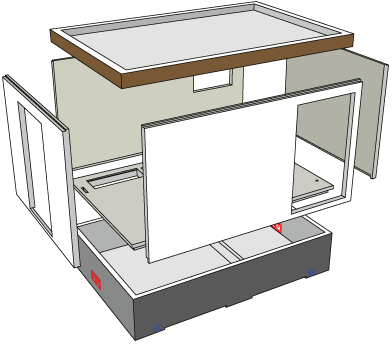
Walk-in station in prefabricated construction with basement
The walk-in transformer station with a basement offers the largest internal space and the widest range of applications. The monolithically manufactured cable chamber is oil-tight without any coating.
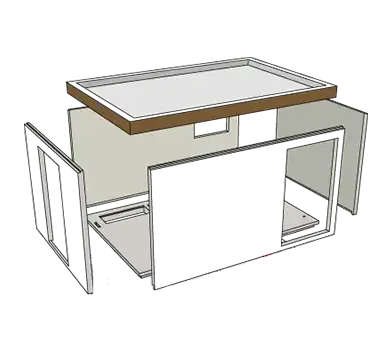
Walk-in station in element construction without basement
The Walk-in transformer station without basement offers weather-protected maintenance and customisable configuration, but does not include a cable cellar.
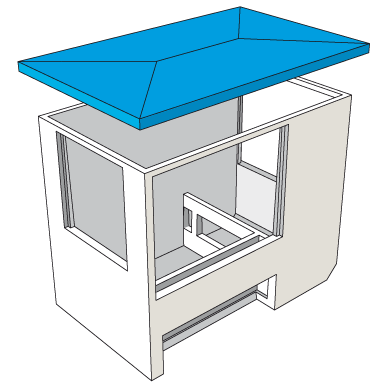
Non-accessible station in cell design (compact station)
The Compact station It is manufactured as a single unit and supplied ready for use. It is operated exclusively from the outside via access hatches. It is particularly space-saving and quick to install.
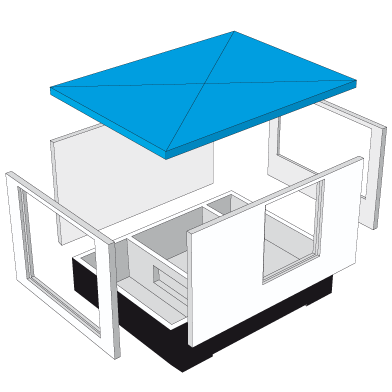
Non-accessible station in prefabricated construction with basement
A combination of space-saving external controls and a modular cable chamber. Used when no accessible internal space is required, but the cables are to be routed beneath the station.
Data sheets available for download as PDF files
Product data, dimensions and connected loads in one document
Each compact station or element station is individually manufactured and unique. In the technical data sheet you will find all relevant data and key figures as well as technical drawings with dimensions and 3D views.
- NZ 150-300 ONS without transformer flap
- NZ 150-300 ONS with transformer flap
- NZ 150-350 ONS with transformer flap
- NZ 150-350 ONS with transformer and remote control flap
- NZ 173-283 ONS
- NZ 173-283 KAH
- NZ 210-240 ONS
- NZ 210-240 XXL ONS
- NZ 210-290 2-room
- NZ 210-290 XXL 2-room
- NZ 210-290 3-room
- NZ 210-290 XXL 3-room
- NZ 240-310 H superstructure -3T
- NZ 240-310 H superstructure -4T
- NZ 240-310 XXL H-body -3T
- NZ 240-310 XXL H-body -4T
- NZ 240-360 MS lateral
- NZ 240-360 XXL MS lateral
- NZ 240-360 XXL H superstructure -36kV
- NZ 240-360 XXL H-body -3T
- NZ 240-360 XXL H-body -4T
- NEK 250-350 H superstructure -1 transformer
- NEK 250-350 H superstructure -2 transformer
- NEK 300-400 H superstructure -3150kVA
- NEK 300-450 H superstructure -4000kVA
Do you have any questions about our products?
Together, we’ll find the right solution.
Features & Equipment: Your substation, customised to your requirements
One Transformer station A von SCHEIDT building is more than just a functional reinforced concrete structure. Every unit can be customised in terms of its façade, doors, floor structure and roof.
Finishes & Colours
Colour tones and facades
The façade of a transformer station does not have to look like a control cabinet. SCHEIDT offers a wide range of finishes and colours, ensuring that every station either blends into the urban or rural landscape or stands out deliberately – including solutions for listed buildings and local planning authority requirements.
- Textured render, roughcast and pebble render
- Cladding with clinker brick slips or imitation half-timbering
- Facade painting and bespoke graffiti design
- Standard colours according to RAL (including 7016 Anthracite Grey, 7035 Light Grey, 6011 Reseda Green, 9010 Pure White)
- Matching the colour of doors and ventilation grilles to the façade
Security for every moment
Doors and ventilation elements
Transformer doors and ventilation grilles are manufactured by SCHEIDT in collaboration with its subsidiary SMA Tech Manufactured to the nearest millimetre to fit any building opening – durable, corrosion-resistant and tested in accordance with DIN and EN standards.
- Aluminium doors with certified protection rating, IP 43
- 3-point locking system with pre-fitted lock, optional panic lock
- Under-door ventilation or top/bottom ventilation grilles
- Optional: double-lock system, T30/T60/T90 fire-rated doors
- Soundproof and burglar-resistant versions available
Interior fit-out
Raised floor system
For flexible interior fit-outs in walk-in transformer stations, SCHEIDT offers a raised floor system as an alternative to the traditional concrete floor. High-density floor panels are laid loosely in a 60 × 60 cm grid on a galvanised, electrically conductive substructure.
- Maximum flexibility during installation, expansion and retrofitting
- Floor panels with glued edges – protected against moisture and mechanical stress
- Locked or unlocked, depending on requirements
- Electrically conductive profiles and steel supports
- Significantly lighter than a traditional concrete floor
Sustainability
Green roof for a transformer station
In principle, any transformer station can be fitted with a green roof or prepared for this at the factory – provided that the roof is structurally capable of supporting the additional load. Extensive green roofing combines functional infrastructure with environmental benefits.
- CO₂ sequestration and natural filtration of particulate matter
- Habitat for insects and greater biodiversity in urban areas
- Additional thermal insulation – lower energy consumption for air conditioning
- Rainwater retention and controlled drainage
- Factory-assembled, low-maintenance planting trays (e.g. ECOSEDUM® PACK)
Do you have any questions about our products?
Together, we’ll find the right solution.
Why choose SCHEIDT for your transformer station?
Thanks to a cleverly designed, smaller model range, SCHEIDT offers a significantly wider variety of turnkey transformer stations than is usual on the market – and is flexible enough to accommodate changes right up until shortly before production begins.
- Reinforced concrete structures of compressive strength class C35/45 – service life of approximately 50 years
- Water- and oil-tight without any additional coating
- Customised configuration rather than standard off-the-shelf sizes
- All models manufactured in-house – BEK, BE, NZ and NEK
- Turnkey delivery, including electrical installations, is available
- Three plants in Germany: Rinteln, Hoyerswerda, Arnstadt
- SF₆-free switchgear – eliminating the use of sulphur hexafluoride (SF₆)
Frequently asked questions about transformer stations
There is no technical difference: Transformer station and Transformer station refer to the same structure. ‚Trafostation‘ is the commonly used short form, whilst ‚Transformatorenstation‘ is the full, technically correct term.
A walk-in transformer substation provides an interior space in which maintenance and switching operations can be carried out regardless of the weather. A non-walk-in compact substation is operated exclusively from the outside and is therefore significantly more space-saving and quicker to install.
SCHEIDT’s reinforced concrete transformer stations are designed to have a service life of around 50 years.
For standard domestic PV systems, the normal domestic connection is usually sufficient. For systems with a capacity of around 270 kWp or more, a separate grid connection and, in many cases, a dedicated substation are required for feeding electricity into the medium-voltage grid.
This depends on the available space, the maintenance requirements and the cable routes at the site. Walk-in substations (BEK/BE) offer more space and convenience, whilst compact substations (NZ/NEK) take up less space and can be installed more quickly. Our team will be happy to advise you.
Yes. SCHEIDT offers standard colours in accordance with the RAL colour chart, as well as a wide range of finishes such as textured coatings, clinker brick slips and coloured stone render. On request, bespoke façade designs and solutions to meet heritage conservation and planning authority requirements are also available.
Do you have any questions about our products?
Together, we’ll find the right solution.

